
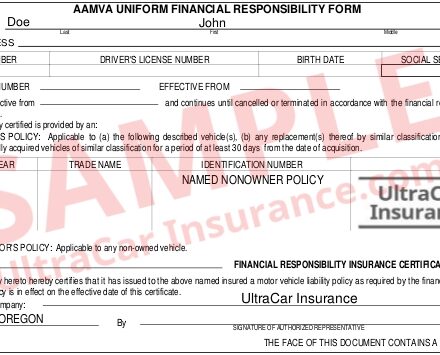
An Oregon SR22 is a certificate issued by an insurance company that proves you have motor vehicle liability insurance meeting Oregon’s financial responsibility requirements.
The SR22 is not a separate type of insurance policy. It is a filing attached to an eligible auto insurance policy or, if you do not own a vehicle, an operator or non-owner policy.
Oregon refers to an SR22 as proof of future responsibility. If Oregon requires you to maintain an SR22, you must keep the filing active until the state says your requirement has ended. Oregon DMV provides current guidance on SR22 proof of future responsibility requirements.
The reason you need an SR22, the type of policy you need and the length of the requirement can vary based on your driving record and the action taken by the Oregon DMV.
When Does Oregon Require SR22 Insurance?
Oregon DMV lists several situations that can result in an SR22 requirement.
- Driving while uninsured
- Being involved in a crash while driving uninsured
- Owning a vehicle involved in an uninsured crash
- A DUII conviction
- Certain other traffic crimes
- Applying for an Oregon hardship permit
This is not a complete list. Your individual DMV notice or driving record determines whether you must file an SR22.
If your driving privileges are currently suspended, see our guide to reinstating your license in Oregon with SR22 insurance.
How Does an Oregon SR22 Filing Work?
The first step is purchasing an insurance policy from an insurer that can issue an Oregon SR22.
Your insurance company then submits the SR22 certificate to the Oregon DMV as proof that you meet the state’s financial responsibility requirement.
Oregon DMV considers the filing effective when the DMV receives the certificate. If you are facing a pending suspension for failing to file an SR22, timing can therefore be important.
Buying an insurance policy by itself does not necessarily restore your driving privileges. You may also need to complete other DMV or court requirements and pay applicable reinstatement fees before you can legally drive again.
After the SR22 is filed, you must maintain the required insurance continuously for the period assigned to you.
How Much Insurance Does Oregon Require?
Oregon’s minimum automobile insurance requirements include:
- $25,000 bodily injury liability per person
- $50,000 bodily injury liability per crash
- $20,000 property damage liability per crash
- $15,000 personal injury protection per person
- $25,000/$50,000 uninsured motorist bodily injury coverage
These requirements are published by the Oregon DMV insurance program.
An SR22 certificate shows that the underlying policy satisfies the financial responsibility requirements that apply to the filing.
You may choose or be required to carry coverage above these minimum amounts depending on your policy and circumstances.
Owner vs. Operator SR22 Insurance in Oregon
Oregon DMV recognizes different types of SR22 certificates.
Owner SR22
An Owner certificate is used when the person required to file the SR22 owns the vehicle or vehicles covered by the insurance policy.
Operator SR22
An Operator certificate is used when the person required to file the SR22 does not own the insured vehicle.
This is commonly what people mean when they search for non-owner SR22 insurance in Oregon.
Oregon can require you to file an SR22 even if you do not own a vehicle.
There is also an “on behalf of” filing that may apply when a vehicle owner files on behalf of an employee or immediate family member under limited circumstances. Oregon DMV explains these certificate types on its SR22 requirements page.
For a more detailed explanation, read Oregon Non-Owner SR22 Insurance: Owner vs. Operator Filings.
Can You Get Oregon SR22 Insurance Without a Car?
Yes.
Not owning a vehicle does not eliminate an Oregon SR22 requirement.
If Oregon requires you to provide proof of future financial responsibility and you do not own a car, you may be able to satisfy the requirement with an Operator SR22 attached to an appropriate non-owner insurance policy.
Non-owner coverage is intended for someone who does not own the vehicle being insured and who needs liability coverage while driving vehicles they do not own, subject to the terms and exclusions of the policy.
If you later purchase a vehicle, tell your insurance company before driving it. Your coverage and SR22 filing may need to be changed to reflect vehicle ownership.
Learn more about Oregon non-owner and Operator SR22 filings.
How Long Do You Need SR22 Insurance in Oregon?
There is no single filing period that applies to every Oregon SR22 requirement.
Oregon changed some financial responsibility rules beginning January 1, 2026.
For a conviction for driving uninsured occurring on or after January 1, 2026, Oregon shortened the SR22 filing requirement from three years to one year.
An SR22 requirement connected to an uninsured accident can still continue for three years.
These changes are reflected in Oregon DMV’s current financial responsibility guidance. Drivers should rely on their individual DMV notice and current state requirements rather than assuming every Oregon SR22 lasts three years.
Other requirements can depend on the particular suspension, conviction or DMV action involved.
Do not cancel your SR22 simply because your license has been reinstated or because a suspension period has ended. Your obligation to maintain proof of future responsibility may continue after you regain driving privileges.
See How Long Do You Need SR22 Insurance in Oregon? for a detailed breakdown of Oregon filing periods and the 2026 changes.
Oregon SR22 and License Reinstatement
An SR22 may be one part of reinstating an Oregon driver’s license, but the filing alone does not automatically resolve every suspension.
Depending on your record, you may need to:
- Review your Oregon DMV suspension or revocation notice.
- Complete any required court, treatment, ignition interlock or DMV requirements.
- Purchase qualifying insurance.
- Have your insurer file the SR22 with Oregon DMV.
- Pay any applicable reinstatement fee.
- Confirm that your driving privileges have actually been restored.
- Maintain the SR22 for the entire required period.
You should confirm your individual requirements with Oregon DMV rather than assuming that buying an SR22 policy means you can immediately begin driving.
Our Oregon SR22 license reinstatement guide explains these steps in more detail.
What Happens If Your Oregon SR22 Coverage Lapses?
If Oregon still requires an SR22 and you stop maintaining the required filing, the Oregon DMV can suspend your driving privileges.
That makes continuous coverage especially important.
Common causes of an interruption include:
- Missing an insurance payment
- Canceling the policy too early
- Allowing the policy to expire
- Changing insurers without arranging a replacement SR22
- Buying a vehicle without updating a non-owner policy
- Assuming the SR22 requirement ended when the license was reinstated
If you want to change insurance companies while an SR22 requirement is active, arrange for the replacement policy and filing before terminating the existing coverage.
The goal is to avoid any gap in the proof of future responsibility Oregon requires.
How Much Does Oregon SR22 Insurance Cost?
There is not one standard Oregon SR22 insurance price.
The SR22 certificate itself is only the proof-of-insurance filing. Most of what you pay is the cost of the underlying auto or non-owner insurance policy.
Factors that can influence your rate include:
- Driving record
- Reason for the SR22 requirement
- Prior accidents or claims
- DUII or other violations
- Age
- Location
- Vehicle
- Coverage limits
- Owner versus non-owner coverage
- Insurance company rating rules
Because insurers can evaluate high-risk drivers differently, comparing multiple companies can produce significantly different quotes for the same driver.
Read Oregon SR22 Insurance Quotes: What Affects Your Rate? for a more detailed look at Oregon SR22 pricing.
Oregon SR22 Insurance After an Uninsured Accident
Oregon made an important change for uninsured accidents beginning January 1, 2026.
The state repealed the previous mandatory one-year suspension that applied to certain uninsured accidents. However, drivers who are required to provide proof of future responsibility after an uninsured accident can still face a three-year SR22 filing requirement.
This distinction is important.
The length of a driver’s license suspension and the length of an SR22 filing requirement are not necessarily the same thing.
Follow the requirements shown on your Oregon DMV record or notice.
Oregon SR22 After a Driving-Uninsured Conviction
Oregon also changed the filing period for certain convictions for driving without insurance.
For qualifying driving-uninsured convictions occurring on or after January 1, 2026, the SR22 requirement was reduced from three years to one year.
Older convictions may still fall under the previous rules.
Because the date and reason for the requirement matter, drivers should not rely on the old rule that every Oregon SR22 automatically lasts three years.
Our Oregon SR22 duration guide explains the difference.
Oregon DUII and SR22 Insurance
A DUII conviction is another situation in which Oregon may require proof of future financial responsibility.
A DUII case can involve requirements beyond insurance, such as license suspension, treatment, an ignition interlock device or other court and DMV conditions.
An SR22 should therefore be treated as one part of the reinstatement or compliance process, not as a substitute for the other requirements associated with the case.
Check your Oregon DMV record and court instructions to determine exactly what must be completed.
Oregon Hardship Permits and SR22 Insurance
Oregon DMV lists an SR22 certificate among the required documents for certain hardship permit applications.
A hardship permit can provide limited driving privileges during a suspension when the driver qualifies, but it is different from full license reinstatement.
Oregon DMV also warns drivers not to cancel their SR22 just because the hardship permit expires. The SR22 requirement may continue afterward.
Your hardship permit application may require additional documentation depending on the reason for your suspension and the driving privileges you are requesting.
See the Oregon DMV hardship permit requirements for current state instructions.
What If You Move Out of Oregon?
Moving to another state does not automatically eliminate an Oregon SR22 requirement.
Oregon DMV states that if Oregon law requires you to file an SR22, you must continue filing with Oregon DMV even if you live outside Oregon.
The SR22 submitted to Oregon must be issued by an insurance company authorized to do business in Oregon, and the policy must meet Oregon financial responsibility requirements.
Before moving or changing insurance companies, confirm that your insurer can continue satisfying the Oregon filing requirement.
Get an Oregon SR22 Insurance Quote
If Oregon requires an SR22, UltraCar Insurance can help you find an appropriate owner or non-owner insurance policy and complete the required filing.
The right policy depends on whether you own a vehicle, the reason for your SR22 requirement, your driving record and the coverage you need.
Compare your options before choosing a policy, then make sure your SR22 remains active for the entire period required by Oregon.